Super Micro (SMCI) Stock Price | Live Chart, Market Cap and FAQs
SMCI is the Nasdaq-listed common stock ticker for Super Micro Computer, Inc. Some Chinese-language quote pages also refer to it as "超微電腦". It is not the same company as Advanced Micro Devices, whose ticker is AMD and which is called "美國超微公司AMD" on pages such as Investing.com. The live chart and market cap on the page should be connected to the latest market data by the system and will change with trading activity; do not treat a figure at a single moment as a long-term conclusion.
When reading this stock, in addition to looking at sales from servers and data center solutions, you should also check whether the latest results are audited financial statements or preliminary unaudited data disclosed by the company, and rely on U.S. Securities and Exchange Commission (SEC) filings.
Key Takeaways
- SMCI is the Nasdaq-listed common stock ticker for Super Micro, headquartered in San Jose, California, primarily providing servers, storage, networking and integrated data center solutions.
- The company's fiscal year ends on June 30. The FY2027 Q1 earnings release states that the figures are preliminary, unaudited estimates, and the quarter-end closing procedures were not complete at the time, so they should not be treated as finalized financial statements.
- According to SEC filings, the former auditor Ernst & Young LLP resigned in October 2024, and BDO USA, P.C. was appointed afterward; in the FY2026 10-K, BDO issued an unqualified opinion on the financial statements but an adverse opinion on the effectiveness of internal control over financial reporting as of June 30, 2026.
- The live chart reflects exchange trading, with regular trading hours from 9:30 to 16:00 New York time; market cap is generally estimated as "share price × shares outstanding" and is not cash on the company's books.
What is Super Micro? Where is SMCI listed?
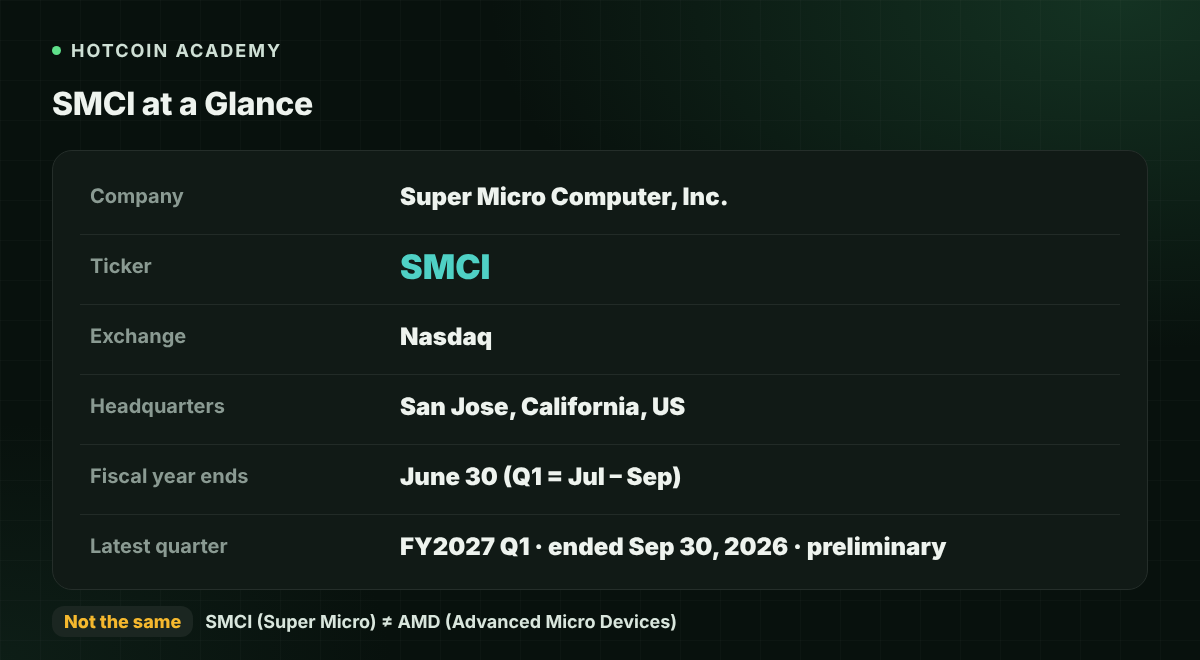
Super Micro Computer, Inc. is headquartered in San Jose, USA. It mainly designs and manufactures servers, AI, storage, IoT and switch systems, and provides related software and support services. It positions itself as an integrated IT solutions provider for enterprise, cloud, AI and 5G/edge scenarios. The stock is listed on Nasdaq under the ticker SMCI. The company's fiscal year ends on June 30, so the first quarter corresponds to July through September.
| Item | Details |
|---|---|
| Full company name | Super Micro Computer, Inc. |
| Ticker | SMCI |
| Exchange | Nasdaq |
| Headquarters | San Jose, California, USA |
| Fiscal year end | June 30 |
| Latest reported quarter | FY2027 Q1, ended September 30, 2026 (preliminary, unaudited) |
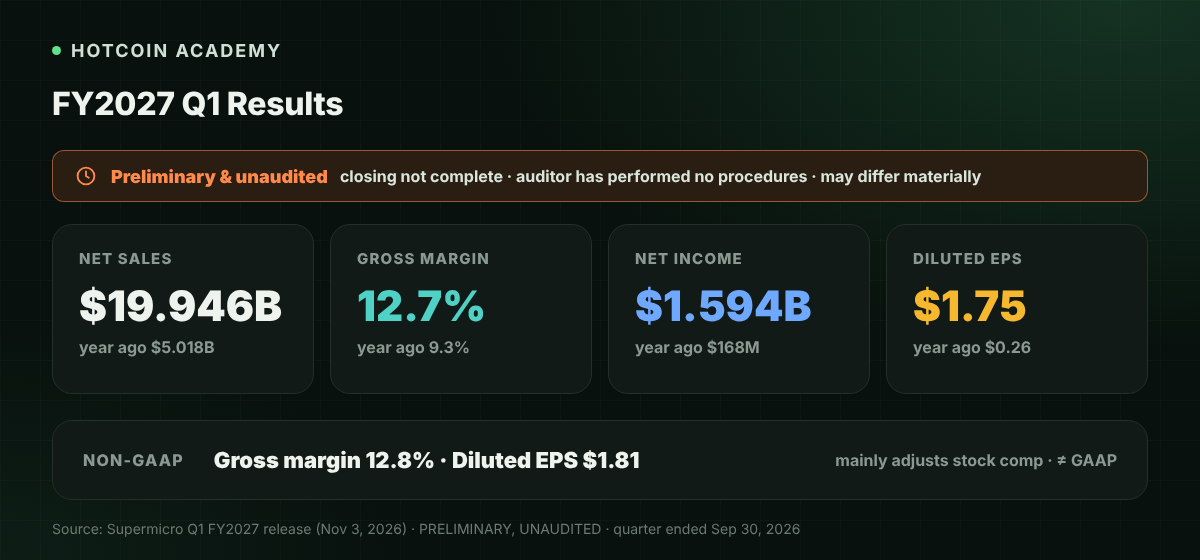
According to the FY2027 Q1 earnings release published on Super Micro's investor relations website on November 3, 2026, net sales for the quarter were $19.946 billion, compared with $5.018 billion a year earlier; gross margin was 12.7%; net income was $1.594 billion, and diluted EPS was $1.75. The release also reported non-GAAP gross margin of 12.8% and non-GAAP diluted EPS of $1.81. Non-GAAP figures mainly adjust for items such as stock-based compensation and cannot replace results reported under accounting standards.
| Item (preliminary, unaudited) | FY2027 Q1 | Year-ago period |
|---|---|---|
| Net sales | $19.946 billion | $5.018 billion |
| Gross margin | 12.7% | 9.3% |
| Net income | $1.594 billion | $168 million |
| Diluted EPS | $1.75 | $0.26 |
What must also be read is this: the release states that the above financial information is preliminary, unaudited estimates, mainly because the closing procedures for the quarter ended September 30, 2026 were not complete at the time; management and audit committee review and other closing processes were still ongoing, and final results could differ materially from the preliminary figures. The release also states that the company's independent registered public accounting firm has not performed an audit, review, compilation or any procedures on these preliminary data. Therefore, these figures should only be treated as preliminary results disclosed by the company at the time and cannot be regarded as finalized financial statements. For final figures, refer to the documents subsequently filed with the SEC.
How does Super Micro make money? How should the latest figures be read?
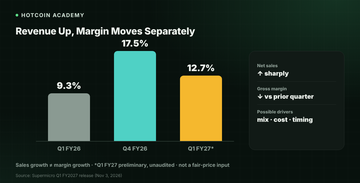
Super Micro's revenue mainly comes from selling servers and data center-related systems to customers, along with related software, services and networking solutions. The company emphasizes its Data Center Building Block Solutions portfolio in the release, but based on the reported quarterly statements, results are presented in a consolidated income statement rather than broken out into multiple reportable segment tables. When reading, net sales, gross margin and net income should be viewed together: an increase in sales does not automatically mean a simultaneous rise in profit margin. Gross margin for the quarter was 12.7%. The same release states that gross margin was 17.5% in the prior quarter (FY2026 Q4) and 9.3% in the year-ago period. Changes in gross margin may be related to product mix, costs and delivery timing, and cannot be used alone to judge whether the stock price is reasonable.
As of September 30, 2026, the release reported cash and cash equivalents of $6.9 billion and total bank debt and convertible notes of $8.6 billion. Cash and debt are balance sheet items and cannot be directly added to or substituted for equity market cap.
Publicly disclosed audit and financial reporting matters
The following information on Super Micro's auditor and internal control over financial reporting is based only on documents filed with the SEC and does not add inferences beyond the filings.
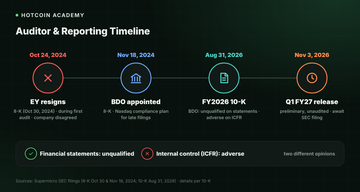
According to the Form 8-K filed on October 30, 2024, Ernst & Young LLP (EY) notified the audit committee on October 24, 2024 that it was resigning as the company's independent registered public accounting firm. The filing states that EY was engaged on March 15, 2023 to audit the company's financial statements for fiscal year 2024 (ended June 30, 2024), had not issued any report on the financial statements or internal control over financial reporting at that time, and the resignation occurred during its first audit period. The 8-K recounts that in its resignation letter, EY stated that recently obtained information made it no longer able to rely on representations from management and the audit committee, and it was unwilling to be associated with the financial statements prepared by management. The company stated in the same filing that it disagreed with EY's resignation decision and did not at the time expect the matter to result in a restatement of FY2024 quarterly or earlier annual statements. The filing also records that the board established an independent special committee to review the relevant matters and certain internal control and governance procedures, and that as of the filing date of the 8-K, the review was not complete.
According to the Form 8-K filed on November 18, 2024, the audit committee appointed BDO USA, P.C. as the new independent registered public accounting firm. The same filing also states that the company submitted a compliance plan to Nasdaq to request an extension to file the then-outstanding FY2024 10-K and the 10-Q for the quarter ended September 30, 2024, so as to restore timely periodic reporting.
Afterward, the company filed periodic reports for subsequent periods. According to the FY2026 10-K filed on August 31, 2026, BDO USA, P.C. issued an unqualified opinion on the consolidated financial statements for the three fiscal years ended June 30, 2026, and stated that it had served as the company's auditor since 2024. The auditor consent filed with the 10-K states that BDO's report on the effectiveness of internal control over financial reporting as of June 30, 2026 was an adverse opinion. The internal control opinion addresses whether the financial reporting process is effective and is not equivalent to an adverse opinion on the financial statements themselves; specific deficiencies, scope of impact and remediation progress should be based on the body of the 10-K. The preliminary figures for FY2027 Q1 still need to be checked after subsequent periodic reports and related reviews are completed.
How to read SMCI's live chart?
The live chart on a quote page comes from securities market trading. It is recommended to read it in the following steps:
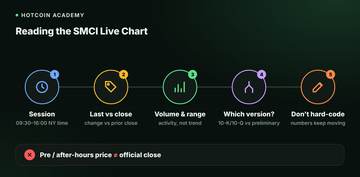
- Confirm the trading session first: U.S. regular trading hours are 9:30 to 16:00 New York time. The corresponding Beijing time differs by 12 or 13 hours depending on daylight saving time, and the time zone marked on the page should be used.
- Distinguish the latest price from the closing price: The latest price is the most recent trade price. Percentage change is usually calculated relative to the prior trading day's official closing price. Pre-market and after-hours liquidity is often thinner, and should not be treated as a confirmed closing result.
- Combine volume with the day's high and low: After news related to AI servers or the supply chain is released, intraday volatility may increase, but high single-day volume does not mean a trend has been established.
- Check which version of the numbers you are using: When comparing price moves with financial data, first confirm whether you are citing a filed 10-K/10-Q or an earnings release still marked as preliminary and unaudited.
- Rely on the page's real-time data: This article does not hard-code the share price, percentage change or market cap at any single moment.
How to read market cap?
Market cap is generally estimated as follows:
Market cap ≈ current share price × shares outstanding
The share count basis should follow the explanation on the quote page. The quarterly earnings release states that the weighted average shares used to calculate basic EPS were approximately 658.1 million, and the weighted average diluted shares used to calculate diluted EPS were approximately 749.4 million. The diluted basis includes potential dilutive instruments such as convertible notes and represents average shares for the period, not the shares outstanding at the close on any given day. The company has also issued securities such as mandatory convertible preferred stock. Net income for the quarter was $1.594 billion; dividing directly by the diluted weighted average share count of approximately 749.4 million gives about $2.13, which does not equal diluted EPS of $1.75. The reconciliation in the same release states that calculating EPS attributable to common stockholders also requires deducting preferred stock dividends and income allocated to participating securities. When calculating market cap, the common share count used on the page at the time should be used.
When reading market cap, remember: it is not cash on the company's books, nor does it equal the amount that would be received if all shares were sold at once at the displayed price; cash, debt and equity market cap are different concepts and cannot be directly added together and treated as the "true value of the company."

Common Misconceptions
- "All figures in the earnings release have been audited": The FY2027 Q1 release explicitly states that these results are preliminary, unaudited estimates, final figures may differ materially, and the subsequently filed SEC documents should be relied upon.
- "An adverse internal control opinion means the financial statements are rejected": In the FY2026 10-K, BDO issued an unqualified opinion on the financial statements and an adverse opinion on the effectiveness of internal control over financial reporting; the two should not be conflated; details are subject to the 10-K.
- "Record sales mean the stock price must be reasonable": Sales, gross margin, debt and share count all change, and revenue scale alone cannot constitute a basis for buying or selling.
Frequently Asked Questions
Q1: On which exchange is SMCI listed? SMCI is the Nasdaq-listed common stock ticker for Super Micro Computer, Inc.; do not confuse it with Advanced Micro Devices, whose ticker is AMD.
Q2: Can the latest quarter's sales and profit be used as final financial statements? No, not directly. The FY2027 Q1 earnings release states that figures such as net sales of $19.946 billion and net income of $1.594 billion are preliminary, unaudited estimates, the closing procedures were not complete at the time, and the independent accounting firm had not performed an audit or review of these preliminary data. For final results, refer to the documents subsequently filed with the SEC.
Q3: Has Super Micro changed auditors? According to the company's 8-K, Ernst & Young LLP resigned as independent registered public accounting firm on October 24, 2024; on November 18, 2024, the audit committee appointed BDO USA, P.C. as successor. BDO stated in the FY2026 10-K that it had served as the company's auditor since 2024.
Q4: How is SMCI's market cap calculated? Generally, current share price multiplied by shares outstanding. Weighted average shares in financial statements or earnings releases are used to calculate EPS, and the diluted basis also includes convertible instruments; these may not equal the share count used on a quote page at a given moment, so refer to what the page displays.
Q5: Can share price alone tell whether Super Micro is expensive? No. Share price does not include information such as share count, gross margin, debt and financial reporting progress, and cannot alone constitute a basis for buying or selling.
Conclusion
SMCI is the Nasdaq-listed ticker for Super Micro. When looking at this stock, first confirm whether the latest financial figures come from a filed periodic report or a preliminary unaudited release, and read the auditor and internal control disclosures according to SEC filings, then return to the quote page to read the live price and market cap; these figures will change with the market, share count and subsequent filings, and the page's real-time display and the company's latest announcements and SEC filings should prevail.
If you also want to distinguish what "price" and "market cap" each explain and do not explain, you can first read What are market cap, circulating supply and fully diluted valuation (FDV)?.
Risk warning: This article is for educational and informational purposes only and does not constitute any investment advice or buy/sell recommendation. The financial figures in this article come from the company's published earnings releases or SEC filings, and some quarterly results were still preliminary, unaudited estimates at the time of release and may be revised by subsequent filings. U.S. stock prices are highly volatile and may cause partial or total loss of principal. Please refer to the company's latest announcements, SEC filings and the real-time data on your page, and make prudent decisions based on your own risk tolerance.
Đề xuất đọc
Xem thêm