
Tesla (TSLA) Stock Price | Live Chart, Market Cap and FAQs
TSLA is the common stock ticker for Tesla, Inc. on Nasdaq.
When reading this stock, first separate the businesses already reflected in the financial statements—automotive, energy and services—and then look at autonomous driving, Robotaxi and humanoid robot projects according to the status the company has disclosed, rather than treating products that have not yet scaled as realized revenue.
Key Takeaways
- TSLA is Tesla's common stock ticker on Nasdaq; the company is headquartered in Austin, Texas, US.
- In Q3 2026, automotive remained the largest revenue source; energy generation and storage, and services and other, were also reported separately in the financial statements.
- For disclosed projects such as Robotaxi, Cybercab and Optimus, distinguish between "already operating or in production" and "still iterating, expanding capacity or subject to regulatory limits"; do not treat plans as profit already booked.
- Market cap is generally estimated as "share price × shares outstanding." It is not the cash on the company's books, nor does it mean all shares could be sold at the displayed price.
What Is Tesla? Where Is TSLA Listed?
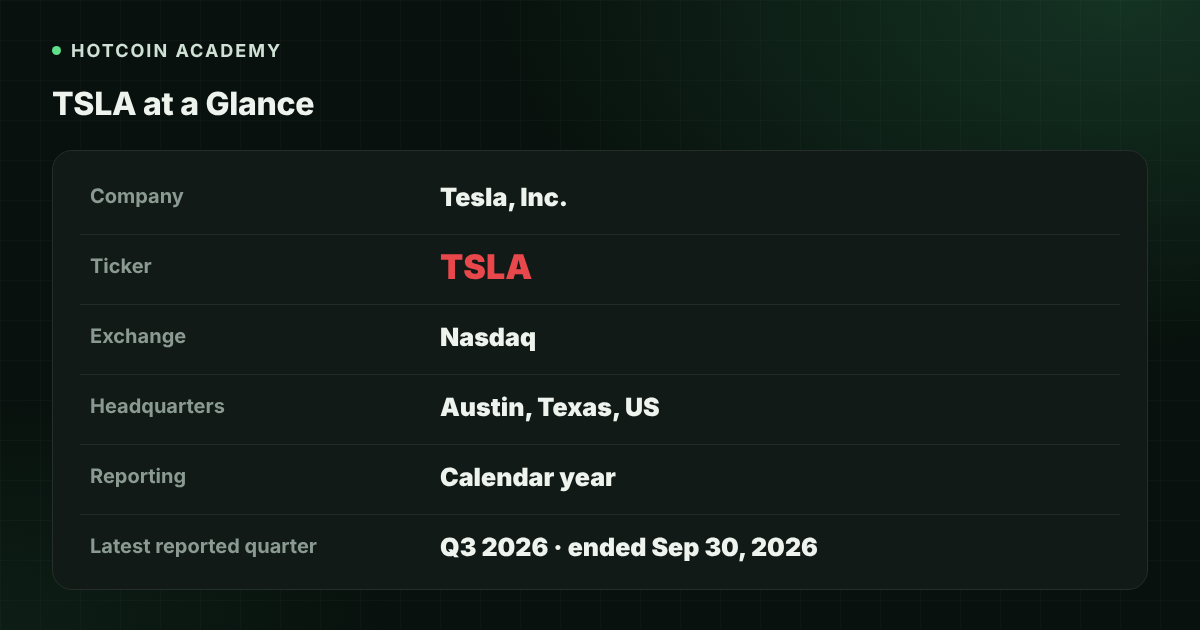
Tesla is a company headquartered in Austin, Texas, US. Its business covers the design, production and sale of electric vehicles, energy generation and storage products, and related businesses such as the charging network, vehicle service and software. The stock is listed on Nasdaq under the ticker TSLA. The company reports results on a calendar-year basis.
| Item | Content |
|---|---|
| Company name | Tesla, Inc. |
| Ticker | TSLA |
| Exchange | Nasdaq |
| Headquarters | Austin, Texas, US |
| Reporting cycle | Calendar year |
| Latest reported quarter | Q3 2026, ended September 30, 2026 |
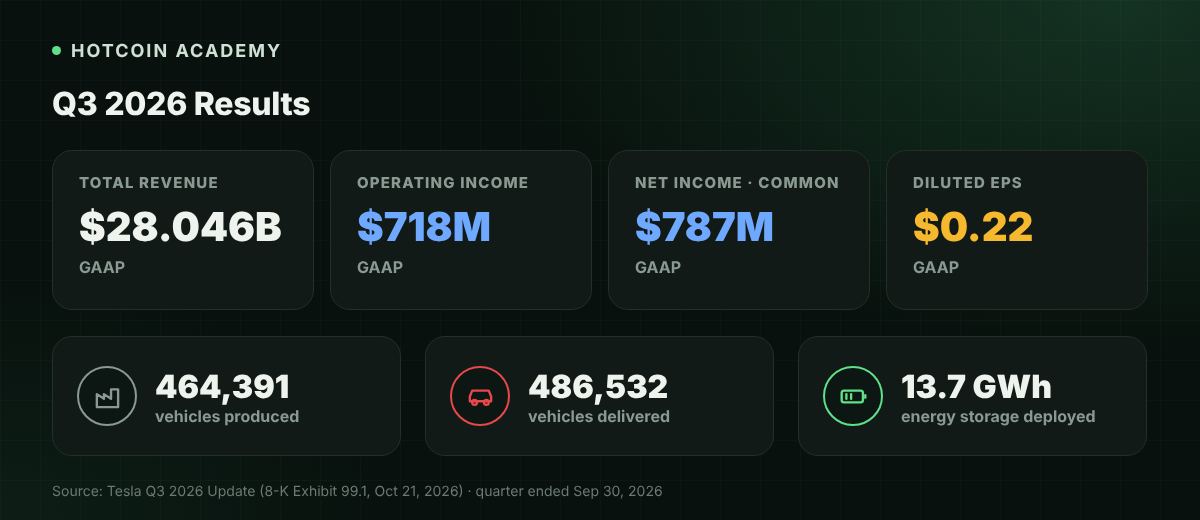
According to Tesla's Q3 2026 shareholder update, released on October 21, 2026 (filed as an exhibit to Form 8-K), total revenue for the quarter was $28.046 billion, operating income was $718 million, net income attributable to common stockholders was $787 million, and diluted EPS was $0.22. Vehicle production was 464,391 units and deliveries were 486,532 units; energy storage deployed was 13.7 GWh. Operating income of $718 million and net income attributable to common stockholders of $787 million are not equal: the same income statement also shows interest income of $445 million, interest expense of $90 million, other net expense of $117 million, income tax of $152 million and noncontrolling interests, which reconcile operating income to net income. These figures come from company-published materials, are updated in later quarters, and the latest filings should prevail.
What Businesses Does Tesla Make Money From Now?
Q3 2026 revenue by the company's financial statement lines is as follows:
| Item | Revenue for the quarter |
|---|---|
| Automotive (including vehicle sales, regulatory credits and leasing) | $20.560 billion |
| Energy generation and storage | $2.881 billion |
| Services and other | $4.605 billion |
| Total | $28.046 billion |
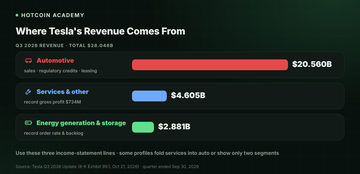
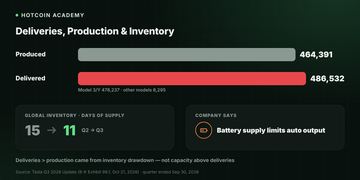
Automotive still accounted for most of the quarter's revenue. Within deliveries, Model 3 / Model Y accounted for 478,237 units and other models 8,295 units, for a total of 486,532 units, above production of 464,391 units in the same period. The same material shows global vehicle inventory (in days of supply) falling from 15 days in the prior quarter to 11 days; deliveries exceeding production is consistent with the inventory decline, and does not mean capacity is already above deliveries. The company also states that battery supply remains a limiting factor for increasing vehicle output. Energy storage orders and backlog reached records in the quarter, and the Texas Megafactory has begun production with planned capacity of 50 GWh. Services and other gross profit rose $86 million quarter over quarter to a record $734 million, but the company does not describe it as having replaced automotive as the main business.
On autonomous driving, mobility services and robots, their status should be understood strictly according to what the company has disclosed:
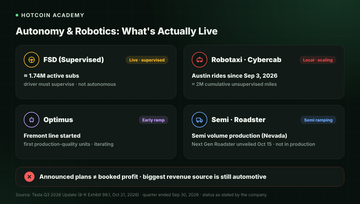
- FSD (Supervised): The company notes in its materials that the feature requires the driver to remain actively supervised and does not make the vehicle an autonomous car. As of the end of Q3 2026, active FSD subscriptions were about 1.74 million (including one-time purchases and monthly subscriptions, excluding free trials). This is a software and subscription metric and cannot be equated with fully commercial driverless operation. The company also states that it continues to work with regulators to seek approval in more markets.
- Robotaxi and Cybercab: The company says that starting September 3, 2026, it began providing Robotaxi rides using Cybercab in Austin and added Cybercab to the local fleet. At the end of the quarter, cumulative unsupervised Robotaxi miles tracked by the company were close to 2 million miles. This is a regional operating milestone disclosed by the company; coverage, regulatory approvals and fleet size may still change, and it cannot be inferred that large-scale commercialization has occurred globally.
- Optimus: The company says the high-volume line at the Fremont factory has begun producing Optimus, with the first "production-quality" robots rolling off, while hardware and processes are still iterating; related capacity in Texas is still under construction. The materials describe it as an early ramp, not a business that already contributes major revenue.
- Semi and next-generation Roadster: The company says it has started volume production of Tesla Semi on a high-volume line in Nevada; the next-generation Roadster was unveiled on October 15, 2026, and as of the quarterly update it was not yet a main model in production.
When reading third-party earnings summaries or company profiles, note that some pages combine timelines that have not yet been achieved (for example, a driverless target for a future quarter or product delivery plans) with disclosed implementation status; some profiles also fold services and other into automotive, or describe the company with only automotive and energy reporting segments. To understand the current business, rely on the status already stated in the shareholder update and on the three revenue lines in the income statement: automotive, energy generation and storage, and services and other.
A factory's "installed annual capacity" is a reference for the upper capacity limit; actual output also depends on equipment utilization, parts supply, line upgrades and regulation. Segment revenue and delivery data help explain the revenue mix and cannot be directly converted into a "fair stock price."
How to Read TSLA's Live Chart
The live chart on a quote page comes from securities market trades. Read it in these steps:
- Confirm the trading session first: Regular US stock market hours are 9:30 to 16:00 New York time. The corresponding Beijing time differs by 12 or 13 hours depending on daylight saving time; rely on the time zone stated on the page.
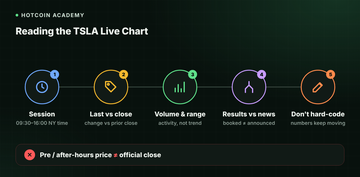
- Distinguish the last price from the closing price: The last price is the most recent trade. The change is usually calculated against the previous trading day's official close. Pre-market and after-hours liquidity is often thinner, and should not be treated as a confirmed closing result.
- Combine volume with the day's high and low: Tesla draws high attention and is volatile; a large single-day range does not automatically mean a trend has formed.
- Separate deliveries, earnings and product progress: Quarterly deliveries, energy deployment and financial statements are operating results that have already occurred; for Robotaxi, Optimus and similar projects, compare against the status the company has stated, and avoid treating news itself as profit already booked.
- Rely on the page's real-time data: This article does not hard-code the stock price, change or market cap at any one moment.
How to Read Market Cap
Market cap is generally estimated as follows:
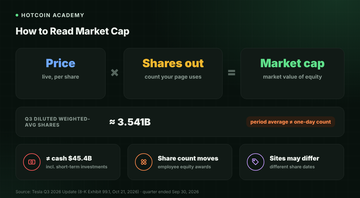
Market cap ≈ current share price × shares outstanding
The share count basis is as stated on the quote page. In its quarterly results, Tesla reported that the weighted-average diluted shares used to calculate diluted EPS were about 3.541 billion; this is the period average and does not equal the shares outstanding at any one day's close. Employee equity award exercises and similar items will continue to change the share count, so use the number the page uses at the time.
When reading market cap, remember: it is not the cash on the company's books, nor does it equal the amount that would be received by selling all shares at once at the displayed price. At the end of the quarter, the company reported cash, cash equivalents and short-term investments of $45.447 billion, which is a different concept from a share-price-based market cap.
Common Misconceptions
- "Tesla already makes most of its money from autonomous driving or robots": Automotive remained the largest revenue source in the quarter. FSD, Robotaxi and Optimus should be understood according to the company's disclosed status, and FSD (Supervised) still requires active driver supervision.
- "If deliveries rise, the stock price must rise": Deliveries are only an approximate indicator of vehicle sales; prices, costs, the energy business, operating expenses and market valuation also matter, and deliveries alone are not a basis for buying or selling.
- "The after-hours price is the next day's opening price": Trading in extended hours is thin, and the opening price still awaits the regular session's matching.
FAQs
Q1: On which exchange is TSLA listed? TSLA is the common stock ticker for Tesla, Inc. on Nasdaq; the company is headquartered in Austin, Texas, US.
Q2: What are Tesla's main business segments now? The financial statements mainly report automotive, energy generation and storage, and services and other. In Q3 2026, revenue for these three was $20.560 billion, $2.881 billion and $4.605 billion, respectively; the company's latest announcements should prevail.
Q3: What is the current status of FSD, Robotaxi and Optimus? According to the Q3 2026 shareholder update, FSD (Supervised) requires active driver supervision and does not make the vehicle an autonomous car; the company says it began providing Robotaxi rides using Cybercab in Austin on September 3, 2026; Optimus has begun production in Fremont but remains in an early ramp and iteration phase. Specific scope and progress are subject to the company's latest disclosures.
Q4: How is TSLA's market cap calculated? Generally, current share price multiplied by shares outstanding. The weighted-average share count in financial statements is used to calculate EPS and does not necessarily equal the share count used on a quote page at a given moment; rely on what the page displays.
Q5: Can the stock price alone tell whether Tesla is expensive? No. The stock price does not include information such as share count, deliveries, profit structure and business maturity, and cannot by itself be a basis for buying or selling.
Conclusion
TSLA is Tesla's stock ticker on Nasdaq. To read this stock, first check the latest reported quarter's vehicle deliveries, energy deployment and revenue mix, then understand autonomous driving, Robotaxi and robotics projects against the company's disclosed status, and then return to the quote page to read the live price and market cap; these numbers change with the market and share count, and the page's real-time display and the company's latest announcements should prevail.
To further distinguish what "price" and "market cap" each explain and do not explain, you can first read What Are Market Cap, Circulating Supply and Fully Diluted Valuation (FDV)?.
Risk warning: This article is for educational and informational purposes only and does not constitute any investment advice or buy/sell recommendation. The financial and operating figures in this article come from company-published financial statements or results materials and may be updated by later filings. Tesla's stock price is highly volatile and may cause partial or total loss of principal. Please rely on the company's latest announcements and the real-time data on your page, and make decisions carefully based on your own risk tolerance.
Recommended
View more