Coca-Cola (KO) Stock Price | Live Chart, Market Cap and FAQs
When you search for “KO” or “KO stock price”, do not treat it as a generic search for the letters “KO”. In US equities, KO is the common stock of The Coca-Cola Company listed on the New York Stock Exchange.
The company does not sell only Coca-Cola. Its brands also include sparkling drinks such as Sprite and Fanta, as well as water, sports drinks, coffee, tea, juice and dairy products, and it sells finished beverages through its bottling investments business. The live chart and market cap on a quote page should come from the latest market data feed and change with trades, so a figure at one moment should not be treated as a long-term conclusion.
To read this stock, first distinguish the operating segments and the differences among concentrate sales, unit case volume and net operating revenues, then return to the quote page to understand price and market cap.
Key takeaways
- The ticker KO refers to The Coca-Cola Company, listed on the New York Stock Exchange. It is not a generic explanation of the word “KO”, nor a separate company for a single beverage brand.
- The company reports mainly by operating segment: Europe, Middle East & Africa; Latin America; North America; Asia Pacific; and Bottling Investments.
- The live chart reflects exchange trading. Regular trading hours are 9:30–16:00 New York time; pre-market and after-hours prices are not the official closing price.
- Market cap is generally estimated as “share price × shares outstanding”. It is not cash on the company’s balance sheet, nor does it mean all shares could be sold at the displayed price.
What is The Coca-Cola Company? Where is KO listed?
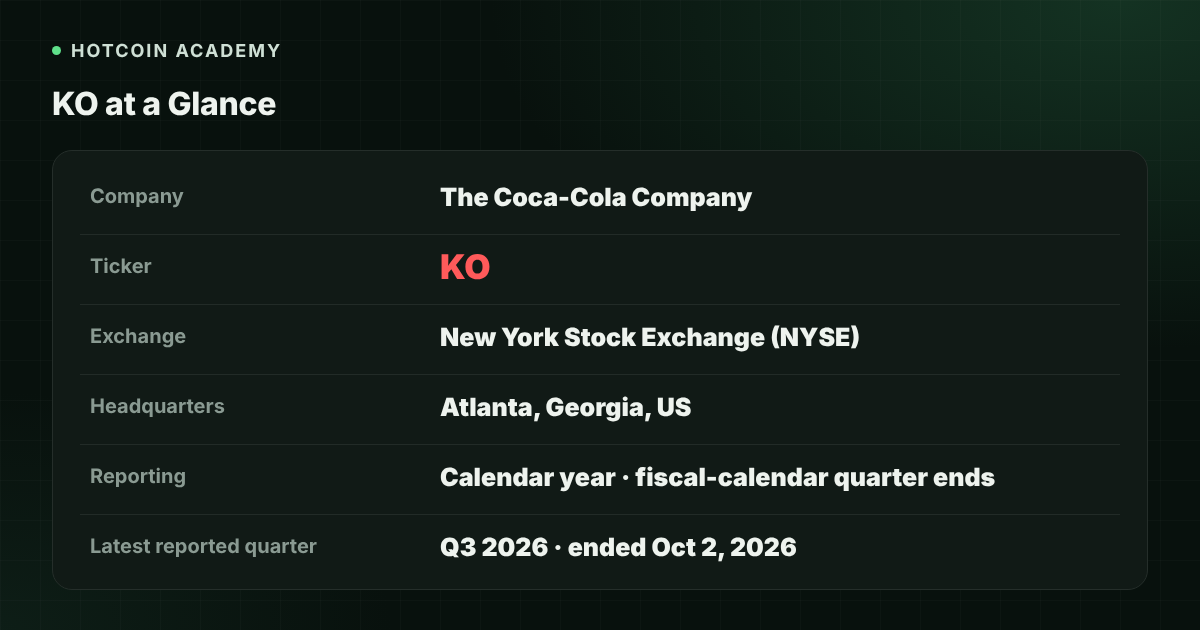
The Coca-Cola Company is headquartered in Atlanta, USA, and is a total beverage company whose products are sold in more than 200 countries and territories. It typically sells concentrates and syrups to bottling partners, which then handle production and distribution; it also operates some company-owned bottling operations through its Bottling Investments segment. The stock is listed on the New York Stock Exchange under the ticker KO. The company reports on a calendar-year basis, but quarter-end dates do not necessarily fall at calendar month-end.
| Item | Details |
|---|---|
| Company name | The Coca-Cola Company |
| Ticker | KO |
| Exchange | New York Stock Exchange (NYSE) |
| Headquarters | Atlanta, Georgia, US |
| Reporting cycle | Calendar year; quarter-end dates set by the company’s fiscal calendar |
| Latest reported quarter | Q3 2026, ended October 2, 2026 |
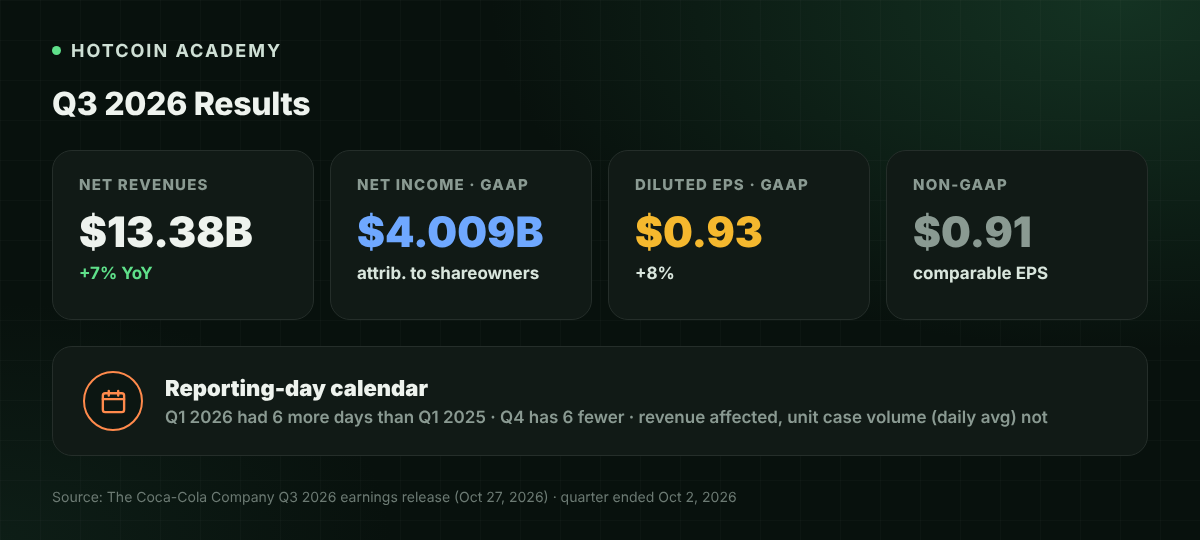
According to the third-quarter earnings release published on The Coca-Cola Company’s investor relations website on October 27, 2026, third-quarter net operating revenues were $13.38 billion, up 7% year over year; net income attributable to shareowners was $4.009 billion, and diluted EPS was $0.93. The release also reported organic revenues (non-GAAP) growth of 7% and comparable EPS of $0.91. Non-GAAP figures exclude certain comparability items and currency effects to help observe operating trends, but they do not replace results reported under accounting standards. These figures come from the company’s published release and will be updated in later quarters; please refer to the latest filings.
The company also noted that Q1 2026 had 6 more reporting days than Q1 2025, while Q4 will have 6 fewer reporting days; unit case volume is calculated on an average daily sales basis and is not affected by this difference in days, but financial figures such as net operating revenues are affected. When comparing different quarters, check such calendar factors first.
How should you read Coca-Cola’s revenue structure?
In Q3 2026, the company reported net operating revenues by operating segment as follows:
| Operating segment | Q3 net operating revenues | YoY (as reported) | Q3 unit case volume YoY |
|---|---|---|---|
| North America | $5.386 billion | +3% | even |
| Europe, Middle East & Africa (EMEA) | $3.104 billion | +4% | +5% |
| Latin America | $1.958 billion | +25% | +6% |
| Asia Pacific | $1.563 billion | +4% | +6% |
| Bottling Investments | $1.523 billion | +13% | +8% |
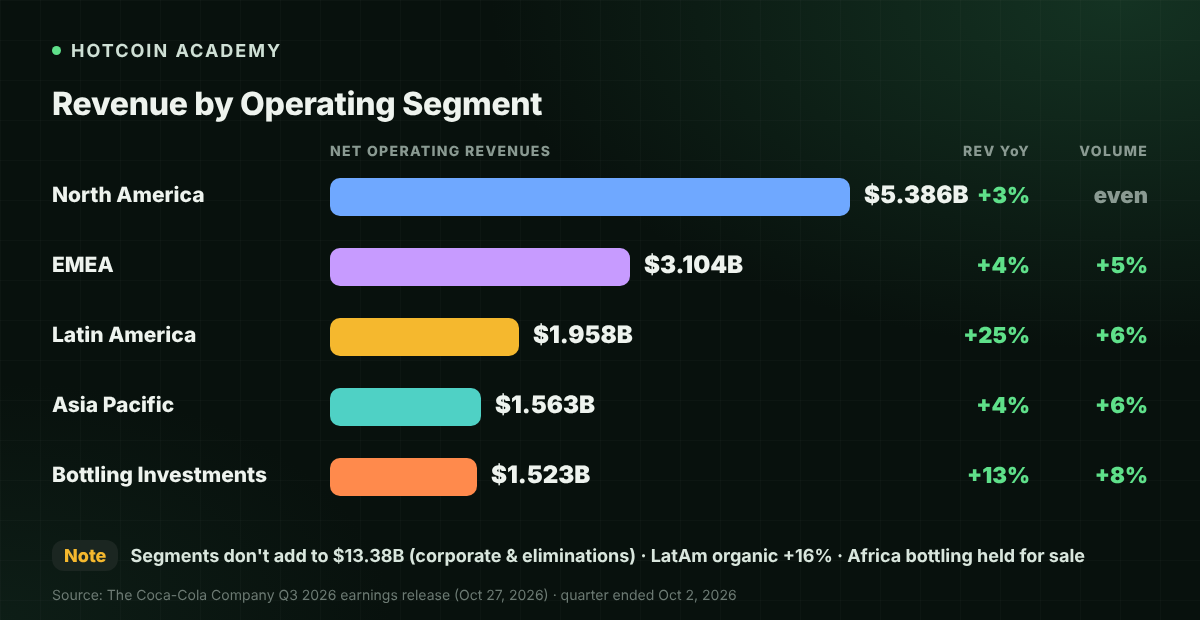
Consolidated statements also include corporate items and intersegment eliminations, so simply adding the table above does not equal consolidated net operating revenues of $13.38 billion. When reading third-party quote pages or company profiles, note that some pages may still use old segment names such as “Global Ventures” in the current business breakdown; the operating segments in the company’s latest earnings release should be the reference. In addition, the earnings release states that the Africa bottling business is classified as held for sale and the proposed sale is subject to regulatory approval; after completion, the scope of the Bottling Investments segment may change, so refer to the latest release. When reading these numbers, at least distinguish three measures:
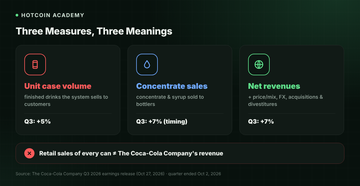
- Unit case volume: measures the volume of finished beverages sold by the company and its bottling partners to customers.
- Concentrate sales: measures the volume of concentrates, syrups and similar products sold by the company to bottling partners. In the quarter, concentrate sales growth was 2 percentage points higher than unit case volume growth, which the release attributed to shipment timing.
- Net operating revenues: also affected by price/mix, currency, and acquisitions or divestitures. For example, Latin America reported net revenues growth of 25% in the quarter, including currency and other factors; organic revenues growth was 16%.
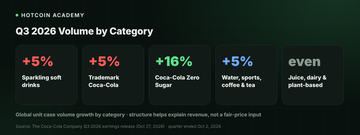
By category, global sparkling soft drinks grew 5% in the quarter, with Trademark Coca-Cola up 5% and Coca-Cola Zero Sugar up 16%; water, sports drinks, coffee and tea combined grew 5%; juice, value-added dairy and plant-based beverages were even. Category and regional structure help explain revenue sources, but cannot be directly converted into a “fair share price”.
How should you read KO’s live chart?
Here, “KO stock price” means the trading price of The Coca-Cola Company’s common stock on the NYSE. It is not a broad search result for the letters KO, nor the retail price of a beverage in a supermarket.
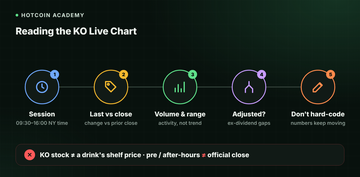
- Confirm the trading session first: regular US trading hours are 9:30 to 16:00 New York time. The corresponding Beijing time differs by 12 or 13 hours depending on daylight saving time; use the time zone shown on the page.
- Distinguish the latest price from the closing price: the latest price is the most recent trade. Percentage change is usually calculated against the previous trading day’s official close. Pre-market and after-hours liquidity is often thin, so those prices should not be treated as a confirmed closing result.
- Consider volume and the day’s high and low: these help judge whether intraday moves are active, but cannot alone prove that a trend has formed.
- Watch the impact of dividends on charts: The Coca-Cola Company pays cash dividends. Unadjusted prices may gap on the ex-dividend date, so check whether the chart is adjusted when comparing long-term performance.
- Rely on the page’s live data: this article does not hard-code the share price, percentage change or market cap at any moment.
How should you read market cap?
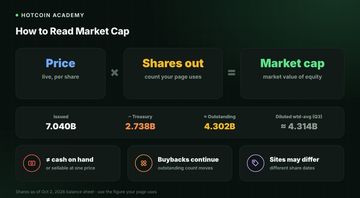
Market cap is generally estimated as follows:
Market cap ≈ current share price × shares outstanding
The share count basis should follow the explanation on the quote page. In its quarterly results, The Coca-Cola Company reported that the weighted average diluted shares used to calculate diluted EPS were about 4.314 billion; this is the average for the period, not the shares outstanding at the close on any given day. As of October 2, 2026, the balance sheet showed 7.040 billion common shares issued and 2.738 billion treasury shares; buybacks will continue to change shares outstanding. Use the figure adopted by the page at the time of calculation.
When reading market cap, remember: it is not cash on the company’s balance sheet, nor the amount that would be received if all shares were sold at once at the displayed price; different websites may use share counts from different dates and therefore show slightly different results.
Common misconceptions
- “Searching KO just means explaining these two letters”: in US equities, KO usually refers to The Coca-Cola Company’s ticker.
- “Coca-Cola’s revenue equals global retail sales of all canned Coke”: most of the company’s revenue comes from selling concentrates and related products to the bottling system, plus some company-owned bottling operations; retail sales at the consumer level should not be treated directly as listed-company revenue.
- “If unit case volume grows, net revenues must grow by the same amount”: net revenues are also affected by concentrate shipment timing, price/mix, currency and acquisitions/divestitures, so the three do not have to move in sync.
FAQs
Q1: What does KO mean? On which exchange is it listed? In US equities, KO is the common stock ticker of The Coca-Cola Company on the New York Stock Exchange, not a generic explanation of the letters “KO”.
Q2: Does The Coca-Cola Company sell only Coca-Cola? No. In addition to the Coca-Cola brand, the company owns sparkling drinks such as Sprite and Fanta, as well as water, sports drinks, coffee, tea, juice and dairy products, and reports revenue across multiple regions and the Bottling Investments segment.
Q3: How is KO’s market cap calculated? Generally, current share price multiplied by shares outstanding. Weighted average shares in financial reports are used to calculate EPS, and issued shares must be adjusted for treasury shares; use the share count adopted by the quote page at the time.
Q4: Do pre-market or after-hours KO prices count as the official closing price? No. The official closing price usually corresponds to the end of regular trading hours; extended-hours prices are separate trades.
Q5: Can share price alone tell whether Coca-Cola is expensive? No. Share price does not include information such as share count, regional structure, currency and profit margins, and cannot alone be a basis for buying or selling.
Conclusion
KO is the NYSE ticker for The Coca-Cola Company, not a generic search result for the letters “KO”. To read this stock, first distinguish the regional operating segments and the differences among unit case volume, concentrate sales and net revenues, then return to the quote page to read the live price and market cap; these figures change with the market and share count, so the page’s live display and the company’s latest releases should be the reference.
If you see US stock-related prices on a crypto platform or quote page, first distinguish whether you are looking at listed-company stock quotes or tokenized stocks or other price-linked products. You can start with What are tokenized stocks? How to enable 24/7 US stock trading.
Risk warning: This article is for educational and informational purposes only and does not constitute investment advice or a recommendation to buy or sell. Financial figures are from the company’s published financial statements or earnings releases and may be updated by later filings. US stock prices are volatile and may cause partial or total loss of principal. Please refer to the company’s latest releases and the live data on your page, and make decisions carefully based on your own risk tolerance.
Recommended
View more